Learn more in this article by James MacDonald at https://daily.jstor.org/the-genetics-of-cousin-marriage/
Showing posts with label DNA. Show all posts
Showing posts with label DNA. Show all posts
Thursday, October 11, 2018
The Genetics of Cousin Marriage
It’s conventional wisdom that procreation between first cousins is unhealthy. But what are the actual genetic risks?
Learn more in this article by James MacDonald at https://daily.jstor.org/the-genetics-of-cousin-marriage/
Learn more in this article by James MacDonald at https://daily.jstor.org/the-genetics-of-cousin-marriage/

Thursday, April 6, 2017
Gene Tool: Quick-Reference Genetic Genealogy Cheat Sheet

Learn the basics of DNA testing with this collection of terms, resources and links courtesy of Family Tree Magazine at http://www.familytreemagazine.com/article/Genetic-Genealogy-Toolkit?platform=hootsuite
Monday, December 21, 2015
Gedmatch's new spreadsheet feature

I am a huge fan of Gedmatch, a tier 1 supporter. It is a place where you can read the tea leaves, and tell the story that your atDNA test results hold for you. TL Dixon on his Roots & Recombination DNA blog just posted about a new feature - a spreadsheet option when you run your Gedmatch kit number (mine is A343022) through the Gedmatch admixture calculators (ie Dodecad, MDLP, PuntDNA, Eurogenes). This new Population Spreadsheet corresponds to your ORACLE results --- simply a population-fitting program measuring your genetic distance to a set of chosen reference populations based upon your Gedmatch admixture calculator results.
You can get more details on his blog at http://www.rootsandrecombinantdna.com/2015/12/gedmatchs-new-spreadsheet-feature.html.
Thursday, June 11, 2015
So You’re Related to Charlemagne? You and Every Other Living European…
Couldn't pass this one by posted by fellow ham radio operator Dick Eastman in his Daily Online Newsletter at http://blog.eogn.com/2015/06/10/so-youre-related-to-charlemagne-you-and-every-other-living-european/. Thanks for sharing Dick.
Adam Rutherford is a former geneticist, now a science writer and broadcaster. He is on BBC Radio 4’s Inside Science, and his most recent book, Creation (Viking 2013), concerning the origin of life, and genetic engineering and synthetic biology.
Rutherford thinks a crystal ball might be just as good as direct-to-consumer genetic testing when it comes to the ‘genetic astrology’ of linking the DNA of modern humans to their famous ancestors.
He writes, “This is merely a numbers game. You have two parents, four grandparents, eight great-grandparents, and so on. But this ancestral expansion is not borne back ceaselessly into the past. If it were, your family tree when Charlemagne was Le Grand Fromage would harbour more than a billion ancestors – more people than were alive then. What this means is that pedigrees begin to fold in on themselves a few generations back, and become less arboreal, and more web-like. In 2013, geneticists Peter Ralph and Graham Coop showed that all Europeans are descended from exactly the same people. Basically, everyone alive in the ninth century who left descendants is the ancestor of every living European today, including Charlemagne, Drogo, Pippin and Hugh. Quel dommage.”
Rutherford obviously doesn’t think much of DNA testing companies that claim to decode your ancestry back to ancient times. He writes, “The truth is that we all are a bit of everything, and we come from all over. If you’re white, you’re a bit Viking. And a bit Celt. And a bit Anglo-Saxon. And a bit Charlemagne.”
There is a lot more to this interesting article at http://goo.gl/yEDnxS.
Saturday, July 19, 2014
DNA testing eyed for graves exhumed from historic Waco cemetery
Waco Tribune-Herald
The committee tasked with planning the reburial of some 300 human remains unearthed from the old First Street Cemetery are hoping to enlist DNA technology in a quest to identify them.
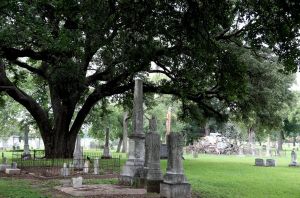 The First Street Cemetery Memorial Advisory Committee has asked Baylor University forensic anthropologist Lori Baker to extract bone samples from each set of remains before the reburial, which is expected in 2015.
The city of Waco discovered the unmarked graves during a construction project behind the Texas Rangers Museum in 2007 and determined they were part of the city’s historic First Street Cemetery, established in 1852.
But so far, none of the remains has been identified.
So the committee this spring turned to Baker, who is known nationally for her work in mitochondrial DNA testing on subjects ranging from prehistoric Americans to migrants who perished in the Southwest desert.
Baker volunteered to collect bone samples that ultimately could be analyzed to establish kinship with living descendants or with other family members in the cemetery.
Do you have someone buried in the Waco, Texas, old First Street Cemetery. Read more at http://www.wacotrib.com/news/city_of_waco/dna-testing-eyed-for-graves-exhumed-from-historic-waco-cemetery/article_7de0ccb2-b2fc-5212-8adc-5c337e9feef2.html.
Subscribe to:
Posts (Atom)